
- News
- City News
- bengaluru News
- The other firth of Ballari
Trending
This story is from October 7, 2017
The other firth of Ballari
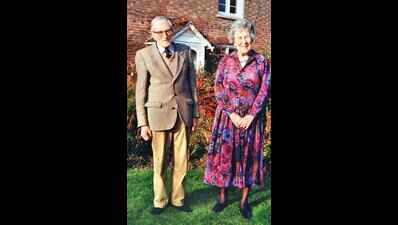
Thinking up a trivia quiz about British actor Colin Firth should be easy.

It is fairly well known that the actor’s parents were born and raised in India. But in his words, he has this “huge history with India,” prompting a few of his family members on their India sojourns to drop in at Ballari too. This town around 300km north of Bengaluru is not really known for playing host to western superstars. Old-time Ballari residents are unaware of any movie links the place might have. “Colin who?” asks N Sabhapathi, an 88-year-old retired priest. He would rather talk about the other Firth, Colin’s grandfather and Anglican missionary Cyril Bruce Firth, better known as CB Firth in these parts.
MISSION HISTORY
CB Firth earned his fame working in rural Karnataka for more than 30 years, initially proselytising the locals, and later making space for local culture in church. In this process, he also helped bring together various denominations and congregations under the ambit of the Church of South India, and wrote one of the first thorough histories of Christianity in India. “An Introduction to Indian Church History is a textbook for theological students and it provides a concise history,” says George Oommen, general secretary of Church History Association of India. For Indian Christians, it is a valuable source of insight into their past.
The history of Christianity is replete with cross-cultural missionaries like Firth. They firmly believed that the new faith would benefit non-believers. Firth and others who landed in India on the cusp of Indian nationalism went out of their way to understand and accept the local culture to communicate their message better. “He was a Kannada pandita and wrote books and translated many into Kannada,” says Sabhapathy about his former teacher.
Firth had a unique role model when he started out. As a young Cambridge graduate in the 1930s, he came under the influence of Richard Hickling, a lay missionary who sang his way into devotees’ hearts through Indian kalakshepam (discourse with music). “Few Europeans could equal him in the facility with which he preached in Kanarese, Telugu and Hindustani,” writes bishop Norman Sargant in ‘From Mission To Church in Karnataka’. Six months of Firth’s first year in India in 1930 were spent under Hickling’s tutelage in Chikkaballapur.
SMALL TOWN PRIEST
It is not clear how Firth, who was part of the London Missionary Society, ended up in Ballari, which was then part of Madras Presidency, and not in a city like Bengaluru. In 1933, he continued the tradition of missionary succession by marrying Ballari missionary EH Lewis’s daughter Mary and took over the reins from his father-in-law.
“They got married in the English Congregational London Mission Chapel, now the CSI Telugu Church, and lived in Rockside Bungalow. All their children – David, Robinson and Jane – were born there,” says Sabhapathi. Firth worked and lived among the villagers in tents for weeks and tried to “improve the spiritual life of the congregation”, writes Sabhapathy in his ‘Lights and Shades of Bellary Churches’.
There were material concerns too. Firth, who was district missionary for 19 years, like his colleagues, faced problems of poverty and debt, writes Sargant. He wrote to higher-ups about village people clamouring for loans and land from a new co-operative
society. ‘To do nothing is to leave them in a state of poverty, dependence and promiscuous living in insanitary quarters, and is a serious setback to the development of a self-respecting Christian community. Such is the dilemma in which we find ourselves,’ he wrote in his report.
He was also worried about the congregation’s moral life that was apparently threatened by ‘basavis’ or devadasis. In typical colonial fashion, basavis are described as ‘loose women, technically married to the god, but who exposed the new Christians to the dead weight of heathenism’. To prevent further corruption, he started a boarding home for young men of the villages.
GOING LOCAL
Firth was quick to cater to the local population in other aspects and introduced the singing of lyrical form of prayers composed by Christian poets like Rev D Thiruvengadaiah. These developments were in line with broader historical changes, especially the rise of Indian nationalism, sweeping India. “The more sophisticated members of the (Christian) community, whose education and social standing gave them a more independent outlook could not but feel the stirrings of national pride,” writes Firth, detailing how foreign missions started evolving into self-sustaining Indian churches at this point. Indian church officials demanded equal status with their European peers, while three young converts from Tirunelveli (in Tamil Nadu) refused to part with their ‘kudumis’ (hair tufts) before baptism.
It was but natural that some of the Indian Christians would seek Indian ways of expressing their devotion through kirtan, harikatha and kalakshepam, or form their own organisations to preach Christianity. Firth advocated in his book that there is no harm in removing what was unnecessarily foreign. “The most obvious of these is church music,” he says, adding that other experiments by churches included organising Christian harvest festivals and adapting the occasional Hindu festival.
“This idea of engaging local culture and indigenous people were probably original in those times. In that sense, his work is original,” says reverend Dexter Maben, who specialises in church history. However, Firth’s account of the church’s history is from the point of view of a white missionary and Indian voices are missing, says Rev Maben. “We all start with the book though it is not considered an authoritative work anymore. Any historiography from a dominant colonial perspective needs to be looked at critically,” he says.
WARM MEMORIES
Old friends like Sabhapathy choose to remember Firth as the friendly principal of Union Kanarese Seminary in Tumakuru, who declined the bishopric of Mysore Diocese like a renunciate and eventually returned to England with his wife in 1965. He died in 1997. “Firth was a thorough scholar in every subject he taught in the seminary. He had good command over Kannada and wrote Christa Vishwasa Suthra Bodhini and other books,” he says.
All his children, including Colin’s father David, took up ‘secular’ jobs, laughs Sabhapathy. David met his future wife Shirley Jean, daughter of congregational ministers, in India, but none of them stayed back. But they have visited Ballari and stayed with him, says Sabhapathi showing a photo of him and David trekking in the Sandur Valley. “David came in the 1970s. Jane came twice and visited Rockside Bungalow, which they had sold for a small amount some 30 years ago. They very much like Ballari,” says Sabhapathi. He says that CB Firth’s wedding photo is also in his possession. “He was my guru and we had a cordial friendship. These memories are still fresh in my mind,” he says.
End of Article
FOLLOW US ON SOCIAL MEDIA





Hot Picks
TOP TRENDING
Trending Stories
In City
Entire Website
- 'We were treated like slaves, made to work for 15 hours a day': Tricked into Ukraine war, 3 from Karnataka return home
- 'My father was on the flight': Jaishankar opens up about 1984 Air India hijack
- Airtel CEO Gopal Vittal sends letter to Reliance Jio, Vodafone-Idea, Tata Tele and BSNL CEOs; here's what he said
- Prince Harry to celebrate 40th birthday away from Meghan Markle
- Haitian immigrant pet-eating row: Ohio woman accused of eating cat is US citizen, video is not from Springfield
- Kejriwal out of jail; 'CBI arrest only to frustrate ED case bail': SC judge
- Donald Trump reveals what Laura Loomer is to his campaign: 'I don't control her'
- Hamster Kombat Daily Cipher Codes and Combo Cards for September 14, 2024: Unlock up to 1 million coins
- Laura Loomer's photo with Donald Trump viral. People ask where's Melania, where's wedding ring
- Garena Free Fire MAX redeem codes for September 13: Win in-game goodies and rewards
- Mamata govt invites protesting doctors for another meeting to resolve RG Kar impasse
- Blast in central Kolkata leaves 1 person injured, area cordoned off
- No driver, no haggling, Mumbai’s BKC aims for friendliest taxi service
- No party more dishonest and deceiving than Congress: PM Modi in Haryana
- Fugitive Zakir Naik misleads Muslims on Waqf bill. Minister hits back
- 'Water reached tomb of Shahjahan': After heavy rain, leakage at Taj Mahal
- Did doctors make a mistake in making Mamata wait for two hours?
- Noida woman loses Rs 27 lakh in SIM card 'hacking': Big mistake she made
- Devil's Brutality: 5 most brutal Hell in a Cell Matches
- Diljit Dosanjh cryptically reacts to sarcastic video on his expensive concert tickets

Popular Categories
Hot on the Web
Top Trends
Trending Topics
Korean TeaSector 36 ReviewGreen Apple BenefitsPriyanka Chopra TattooKottukkaali OTT ReleaseNarendra ModiGhaziabad Juice SellerHair LossSudha MurtyMalayalam ProducersIndia's Best Dancer 4Simi GarewalDilli BabuIndian National ParksLaung BenefitsVikas SethiApple iPhone 16Donald TrumpAadhar Card Update By Sept 14Wordle Answer
Living and entertainment
Latest News
Kaun Banega Crorepati 16: Can you guess the answer for this Rs 3,20,000 question on Navy, which contestant Naman Jain incorrectly answered?Edible oil import duty hiked by 20%'Calling all Swifties for Trump': Donald's new campaign merch imitates Eras Tour shirtsWWE Hall of Famer Watches 15 Hours Of Wrestling Each WeekDallas Cowboys Set to Defend AT&T Stadium in Week 2 Clash with New Orleans SaintsTovino on training for Kalaripayattu in ‘ARM’: I practiced every single day, even if I had a hectic day on set8 animals that reproduce without matingDelhi Police Files FIR for Firecracker Celebration Outside CM Kejriwal's ResidenceThrowback: When Alia Bhatt responded to insecurity questions about Ranbir Kapoor, shut down gossipIndia's T20I captain Suryakumar Yadav turns 34: A glimpse into his stellar T20 careerThe 3 Strongest Zodiac Signs: Powerhouses of the Zodiac Wheel'Forgive me, I don't belong ...' : Tamil Nadu hotelier's apology to FM Nirmala Sitharaman over GST remark triggers political rowRakul Preet Singh reveals Bollywood stylists charge from Rs 15000 to Rs 1 lakh for one event, one outfit: 'Living in Mumbai requires a lot of PR'September 14, 2024: Flying creatures and how their wings workThrashed for 'molesting' kid on train, rail staffer diesKejriwal walks out of jail, says morale is up by 100 timesDhruv Kapila's health setback shatters Indian pair's Vietnam Open semifinal hopesFormer Titans Cheerleader Danielle Sekelsky Begins WWE NXT Training
Copyright © 2024 Bennett, Coleman & Co. Ltd. All rights reserved. For reprint rights: Times Syndication Service